Tuesday, 14 May 2013

400

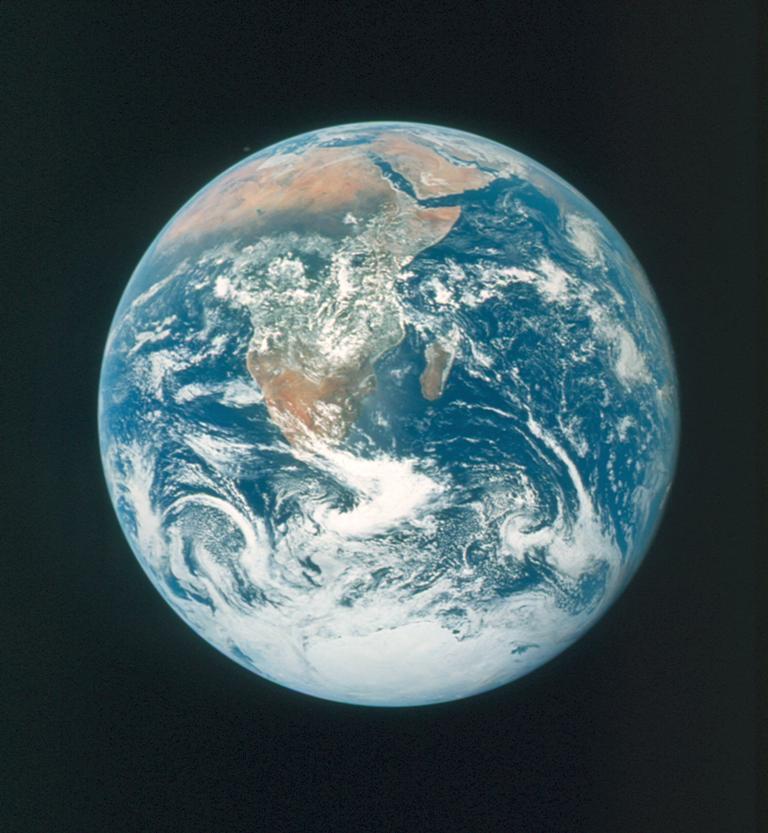
We humans like round numbers.  We don't celebrate the 23rd annual summer fete or the 49th anniversary of an organisation but the 25th or 50th respectively. This is why the quantity of carbon dioxide in the atmosphere has hit the headlines this week. The daily measurement at Mauna Loa on Hawaii has passed 400 ppm (parts per million) for the first time. Not so much a cause for celebration; more a cause for commiseration  The actual measurement was 400.03 but was subsequently revised down to 399.89 (but what is fourteen hundredths of a part per million between friends). Breaching this threshold was not particularly unexpected but it is symbolic in human terms; it is a memorable number.


But what are the implications of exceeding a CO2 concentration of 400 ppm?

Some climate change skeptics will be quick to highlight the scientific evidence that shows the atmospheric CO2 has been at this level and higher on the past. They are absolutely correct. Somewhere in the region of three to five million years ago similar levels were present and the world was, on average, three or four degrees Celsius warmer with some areas up to ten degrees warmer. Life survived and flourished and it is likely to have influenced the evolutionary path that led to Homo Sapiens but humanity in its current form has never experienced the like, and as far as we can tell, the changes in CO2 levels were never as rapid as over the last 150 years.

We will not wake to a radically different world tomorrow.  Climate change does not work like that.  If we maintain CO2 levels at 400 ppm, without any further increase, it will take decades or even centuries for a new "normal" climate to become established.  Some areas will dry out, others will become wetter, some will cool and others warm, all of which will change natural vegetation and agricultural practices which will feed back into local and global weather systems.  The biggest threat for the human population will be the increased frequency of crop failures.  In order to cope with the still growing human population combined with  climatic changes will require more wilderness to be tamed for agriculture.  Perhaps the tundra will be drained for fields once the permafrost melts.

Longer term effects will be the thawing of glaciers and ice caps which will raise sea levels and affect ocean currents and hence the climate.  Some estimates indicate that when the world last saw 400 ppm CO2 sea levels were 40 metres higher than now. While a rise in sea level of that magnitude may not happen for a century or more, it would be catastrophic for the world as we know it. It wouldn't just be island states such as the Maldives that would disappear but large parts of low lying countries, such as Bangladesh and the Netherlands.  Our ever more crowded cities will be badly affected too.  The first few floors of the newly topped out One World Trade Center in New York will be submerged as will many parts of the Eternal City, which has been inhabited for two and a half millenia.  Some of the world's most densely populated cities, such as Tokyo, Cairo and London, will be much depleted.

This will lead to hundreds of millions, perhaps billions, of people being displaced by rising sea levels again putting pressure on the wilderness.  The new homes and infrastructure that will be required on a scale never before experienced will demand vast quantities of energy and natural resources. It won't be the end of the human race but it may suspend our humanity as wars, famine and pestilence of biblical proportions are likely as greater numbers compete for limited resources.


Such a dark future is by no means certain. We still have a little time to act, but not long.  The more we procrastinate the harder it will be to head off the worst extremes coming our way.  If we continue with "business as usual" we are on target for 450ppm by the middle of the century, accompanied by six degrees Celsius temperature rises. That doesn't bear thinking about.


Related Links:
http://www.guardian.co.uk/environment/interactive/2013/may/10/climate-warming-gas-carbon-dioxide-levels-interactive

Saturday, 30 March 2013

Testing Times

What is the point of exams?

Is it to test the candidate's knowledge of the subject or is it to test the candidate's skill in passing exams? In theory at least, it should be the former but when there is a lot riding on the result there is a tendency towards the latter with students placing more emphasis on training to pass the exam rather than gaining a deep understanding of the subject. The student may gain some knowledge of the subject, but only those parts that will gain most marks in the exam as part of a strategy to maximise the result for minimum effort.


This doesn't only apply to academic exams.  Similar strategies can also be adopted for all sorts of tests.  For example, if a car maker wants their car to get a good fuel efficiency rating they can work on scoring better in the test, rather than improving the car's performance.  They can use non-standard high performance lubricants, disconnect the alternator, over inflate the tyres, remove door mirrors and even tape up joints in body panels to improve the test results. Car manufacturers have got so good at performing well in tests that the average gap between quoted fuel efficiency and actual real world fuel efficiency has grown from 7% in 2001 to 23% in 2011 according to figures from Germany.  In fact the real world fuel consumption has been shown to be as much as 50% higher than the official test figures for some vehicles.("Mind the Gap:Why official car fuel economy figures don't match reality")

While no rules or regulations are broken by manipulating the test results, there is certainly an intent to deceive or mislead the consumers and governments (some of which set taxation levels depending on the results of the tests).  This approach to testing taken by car makers could account for as much as half of the fuel efficiency improvements between 2002 and 2010 according to a study undertaken for the European Commission. This makes it difficult for car buyers to make an informed judgement about which models are more efficient. There is, apparently, further scope to improve test results without improving the performance of the production car.

Once you've bought a shiny new supposedly fuel efficient car it is fairly easy to compare your real world fuel consumption with that advertised.  To calculate your fuel consumption:
1) Fill the tank completely and note down the odometer (mileage) reading;
2) Fill the tank again after a few hundred miles, note the odometer reading and the amount of fuel used to fill the tank;
3) Calculate fuel consumption in milers per gallon (mpg):
       [(2nd Odometer reading) - (1st Odometer reading)]/(fuel used in litres/4.55) = mpg
Once you have calculated your fuel consumption and found it to be significantly greater than advertised, what recourse do you have? Under trading standards regulations, you would expect recourse if the product differed from that advertised and advertising standards, manufacturer's must be able to justify their advertised claims.  Unfortunately the consumer loses out in both cases as the manufacturer has testing data to justify their claims and they do not advertise the real world performance or the performance that you should expect, only the performance under a set of loosely defined test criteria.

The Future of Fuel Savings

The European Union is considering future emissions from new cars including setting a target to 95 g CO2/km on average for new cars by 2020.  According to some reports motorists will save £350 per year on fuel thanks to the new emission levels, which will pay for the additional cost of the new car in three years.  Presumably this is based on average mileage and real world fuel efficiency improving at the same rate as the quoted tested efficiency.  If real efficiency savings are half of the test values then the pay back time would double and, for those who drive less,  there may never be enough savings of fuel to cover the additional capital cost of the car.  This is not the incentive we need to reduce fuel consumption.

Media Perception

The New York Times recently reported on a road test of a Tesla electric car, in which it highlighted major shortcomings in its energy use performance, specifically its range.  This clearly of much greater significance than the fuel efficiency of a petrol or diesel car as they can be quickly and easily be topped up with more fuel  at one of many filling stations unlike the electric car which takes time to top up the battery at much less common charging points.  Nevertheless, the emphasis on fuel consumption seems disproportionate with the media generally accepting manufacturer's performance claims, perhaps accepting that real world fuel consumption may be a bit higher than test conditions but certainly not emphasising the growing disparity between quoted performance and actual performance.  One may suspect that they do not want to challenge the car makers to much in case the supply of shiny new toys to test drive is curtailed...

Conclusion

In conclusion, we need:
1. A more accurate test that better simulates real driving conditions and is based on sample cars off the production line or from the forecourt without any modifications.
2. More robust challenging of fuel efficiency claims across all car types by the motoring press.
3. Genuine increases in fuel efficiency.
In addition, we must also focus on alternatives to the car, such as active travel, public transport, private group travel and reducing demand for travel, some of which will be covered in further posts.

Sunday, 24 March 2013

What I Learned During Earth Hour

A book and a wind-up torch.

During Earth Hour, I learned the following:
  1. The origin of apples;
  2. A little about the last few months of Leon Trotsky’s life before being exiled;
  3. That I can still read a book in the dark with a torch (like I did as a child, under the blanket after bed time);
  4. And, thanks to @glasgow_kat, that petrochemical candles have much higher emissions than an electric light.
Earth Hour is a fantastic way to highlight the problem of climate change in solidarity with people across the globe but it is not enough on its own. Switching the lights off on landmarks from Sidney Opera House to the Eiffel Tower to the Empire State Building for one hour is purely symbolic. Even switching them off permanently would be insignificant. The kind of reduction in fossil fuel use that we need to achieve would be more like everyone everywhere turning off the lights, heating, air conditioning, refrigeration, computers, televisions - everything for an hour. Not just once a year, a week or even a day but for four or five hours a day with all if the saved energy being from fossil fuels. And without increasing consumption in the periods in between. 

It is a huge challenge but it is the one we face if we are to have a hope of avoiding the worst consequences of climate change and we can't afford to wait until next year to face it.

And the apples? They originated in the area around present day Almaty in Kazakhstan.

Tuesday, 12 March 2013

The 100th Post - A Retrospective

On noticing that this would be EcoWarriorMe's 100th post, I thought it would be a good opportunity to review what we set out to do and how the blog has developed over the past two years and to highlight some of the most popular posts and personal favourites.

The blog was born of a frustration at the general apathy and lack of progress towards a more sustainable society including climate change, pollution, wasteful squandering of precious resources and the relentless despoiling of our natural environment.  I aimed to highlight things that we can do to reduce our negative impact and demystify some of the competing arguments for and against particular courses of action.  I knew that I didn't have all of the answers and I still don't. I don't even know all the questions although I'm working on that. I enjoy learning and am interested in the science and engineering on which our modern society is based but I expected to probe a bit deeper rather then taking things at face value: it says its greener so it must be, or is it? I hoped to use this desire for knowledge, and sharing the knowledge, to stimulate debate and encourage others to also ask the awkward questions.

The first few posts were little more than re-posts of other article with some additional commentary, such at the first post on the use of biofuels in transport at the expense of deforestation and rising food prices.

One of the first full posts was on the Fukushima disaster, where I suggested that this incident shouldn't be used as an excuse to reject nuclear power. There are sufficient other reasons to avoid nuclear power.

Not long after starting this blog, the Scottish National Party were returned to power at Holyrood with a commitment to achieve 100% of Scotland's electricity from renewable sources by 2020 - a bold target by any standard, one of the toughest targets in the world.  In reality, Scotland is an integral part of the UK's National Grid and it will continue to rely on non renewable sources of energy as part of balancing mechanisms beyond 2020.  The mix of generation in the UK as a whole is therefore relevant, hence the review of a paper in the journal Engineering Sustainability on possible scenarios to meet targets for low carbon electricity and to assess the possible energy mix in 2030 in what has been one of the blog's most popular posts.

While it is important that we tackle the causes of climate change - and our energy mix is a big part of that - it is also important that we do not lose sight of the many other environmental issues competing for our attention.  These include population growth, pollution, recycling, habitat loss, loss of biodiversity and access to safe food, water and sanitation. This list is, of course, not exhaustive.

One of the blog's aim is to investigate whether green claims really stack up.  This is often difficult because a product may be designed to improve its environmental performance in one regard but within unintended consequences in another.  Examples include using less packaging which could result in a higher carbon footprint and more waste to landfill, zero emission electric vehicles that still have emissions.

Certain posts have proven more popular than others and the five most popular posts of all time have been:
1. Plastic bags: it's not all about carbon - there is more to the eternal plastic bag than simply its carbon footprint;
2. Clyde Fastlink - A Revolution in Public Transport - Glasgow's big investment in a marginal public transport scheme while the city chokes on polluted air;
3. 2030 Electricity Generation Mix - a review of possible scenarios for the UK's future low carbon energy supply;
4. Tell Shell - promoting the Greenpeace campaign to stop Shell drilling in the arctic;
5. The Big Energy Switch Swindle? - on a futile attempt to take on the energy oligopoly.
In addition to the Tell Shell campaign at number four above, the blog has also supported the Tigertime campaign to stop tiger farming and end the legal trade in tiger parts in China, Water Aid's campaigns for universal access to drinking water and sanitation, a local campaign opposing a waste incinerator and a campaign to encourage MSPs to stick to their targets for reducing carbon emissions. While this is not the main purpose of the blog, it is a useful platform to promote these causes and make connections between different areas of concern.

Although not the most popular, some personal favourite posts are:
The Aralkum Desert - one of the starkest examples of how careless exploitation of natural resources has led to ecological catastrophe and creation of the world's newest desert;
Summer Holidays - about tracking of British cuckoos on their long migration to central Africa;
Here Comes the Rain - Part 1 - a basic analysis of rainfall records of Paisley (Glasgow Airport) over the past 50 years;
Rest and be Thankful, but not about Climate Change - some anecdotal evidence of the direct influence of climate change;
Sea Levels are Rising - presenting some evidence of rising sea levels;
Milk - os the true cost of your daily pinta.
Quite a mixed bag that represent the range of EcoWarriorMe's interests, all topics which may be revisited.

It is all well and good to reflect on the past and possibly learn from it but what about the future? It's where we are all going and it is when we must make the big changes. Many things about our modern lifestyles must become more sustainable, making more efficient use of scarce resources and protecting the natural world.  Future EcoWarriorMe posts will attempt to cover some of these topics such as how we can use energy more efficiently and increase use of renewables, how we transport people and other stuff about, including active travel, commuting, aviation and eco-tourism and conservation of wildlife and natural resources.

We must understand the problems before we can evaluate the solutions, then as the solutions are developed we must convince society to adopt the solutions.  This transition from pure science: the maths, physical, chemical and biological processes of climate through to engineering solutions follows well established principles but sociological and psychological obstacles lie in the path widespread adoption of sustainable societies and lifestyles.  This is another area for further investigation by EcoWarriorMe.

EcoWarriorMe invites you along on the journey to discover what we can do and what we can ask others to do on our behalf. We only have one world, let's make it last.

To the Future!


Tuesday, 26 February 2013

Nature's Connections

On the fundamental interconnectedness of all things.

Simple cause and effect is not enough to explain a chaotic world. A single action seldom result in a single reaction. More often, it triggers a chain of reactions, a wave of perturbations through the fabric of reality, like ripples on a pond. Some are obscure, like dropping a small pebble in a big ocean while others stand out like a large rock dropped in a mill pond with long lasting ripples reflecting back from the edge generating complex interference patterns. 

It may sound philosophically abstract but here are two examples of such complex interactions in nature.  The first involves the smallest primate, Madame Berthe's Mouse Lemur and the second involves the largest land mammal, the African Elephant.

Wednesday, 20 February 2013

A Commitment to Low Carbon Electricity

I received the following e-mail from Greenpeace on a very important topic: the UK's commitment to reducing greenhouse has emissions in electricity generation. The draft Energy Bill does not yet have such a commitment so read on to find how you can help ensure it makes it into the final bill and please spread the word: